
There is a moment in every kitchen remodel — usually somewhere between finalizing the cabinetry and selecting the countertop — when attention turns to the smaller things. The pulls. The faucet. The cabinet knobs. The pendant lights over the island. These are the details that homeowners sometimes treat as an afterthought, something to circle back to once the bigger decisions are settled.
It’s a mistake that experienced designers recognize immediately. Hardware and fixtures are not the finishing touches on a kitchen. They are the punctuation — the elements that give the whole composition its style, its character, and its sense of resolution. Get them right, and a kitchen feels complete in a way that’s difficult to articulate but impossible to miss. Get them wrong, and even a beautifully designed space can feel slightly unfinished.
Start with Finish, Not Style
The most common mistake homeowners make when selecting hardware is leading with shape, like a particular drawer pull they love in a photo, before establishing the finish that will carry through the room. Finish is the thread. It’s what the eye follows from the faucet to the cabinet pulls to the light fixtures to the range hood, and it’s what creates the sense of intention that separates a curated kitchen from a collected one.

Warm bronze fixtures and hardware tie the room together — New Hope Kitchen Remodel
The current selections of metal finishes offer more sophistication than they ever have. Brushed brass and unlacquered brass have brought warmth back into kitchens that spent years in chrome and stainless. Matte black is still a strong choice — graphic and grounding without the coldness of polished nickel. Brushed nickel and satin brass occupy a softer middle ground that works particularly well in transitional kitchens where the design speaks to both traditional architecture and contemporary sensibility.
The rule that governs it all is consistency. This doesn’t mean every metal in the kitchen must be identical. Mixing a warm brass faucet with matte black cabinet hardware can be done beautifully when the contrast is deliberate. But it requires intention. Hardware that mixes finishes without logic is what makes a kitchen feel like its selections were made at different times by different people.
Cabinet Hardware: Scale, Proportion, and Restraint
The relationship between cabinet hardware and cabinetry is one of proportion as much as style. Oversized pulls on delicate inset cabinets look heavy and wrong. Modest knobs on a substantial shaker-style island disappear. The hardware should feel like it belongs to the cabinet. It should be sized for the door or drawer it’s on and scaled to the room as a whole.
Bar pulls and cup pulls tend to work well in kitchens with clean-lined, contemporary cabinetry. Their lines reinforce the geometry of the space. Bin pulls and bridge pulls have an older, more artisanal quality that suits transitional and traditional kitchens, particularly in historic Bucks County homes where the architecture carries its own period character. Knobs, used selectively on upper cabinet doors while pulls are used on drawers and base cabinets, add visual variety without chaos.
One often-overlooked decision is placement. Drawer pull placement (centered or offset toward the top) is something a designer will have a clear opinion on, and it’s worth asking. The consistency of that placement across every cabinet in the kitchen is one of the details that reads as careful craftsmanship when it’s done well, and as inattention when it isn’t.
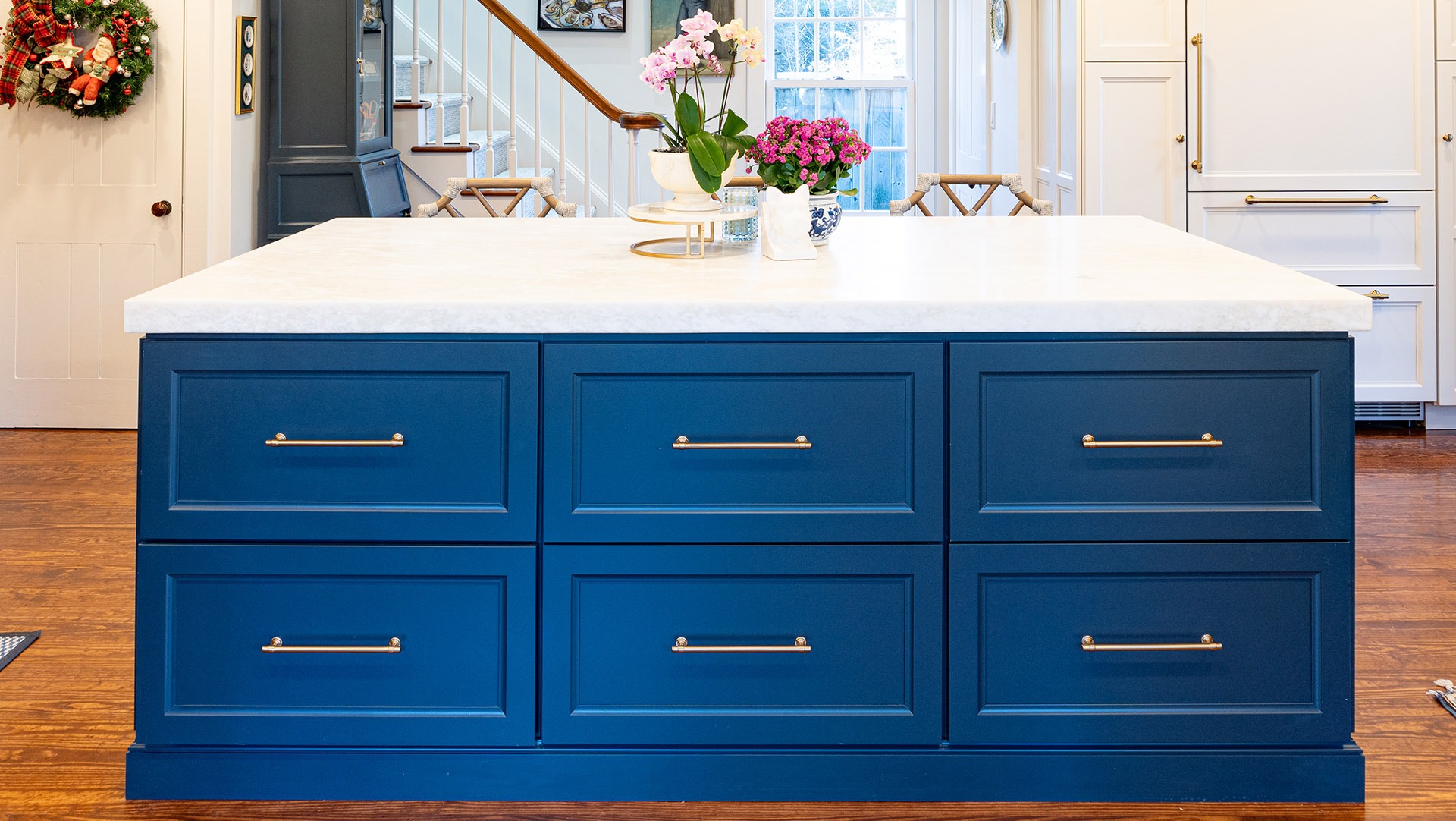
Brass hardware on custom cabinetry — Doylestown Kitchen and Bath Remodel
The Kitchen Faucet: The Room's Most-Handled Fixture
Of all the fixtures in a kitchen, the faucet is touched more than any other. It’s also one of the most visible. It deserves serious attention, both for its aesthetic contribution and for how it performs over years of daily use.
Pull-down and pull-out faucets with high arches have become the standard in kitchens designed for serious cooking. They offer the flexibility needed for filling large pots and cleaning the sink. For kitchens with a more refined or minimal character, a sleeker bridge faucet or a wall-mounted fixture above an apron sink makes a quietly considered statement. Pot fillers mounted above the range are no longer a luxury feature reserved for high-end restaurant kitchens; for homeowners who cook often, they’re a practical convenience that also adds a layer of intentionality to the range wall.
Whatever style the faucet takes, its finish should speak directly to the hardware on the cabinets nearby. A brass faucet beside matte black pulls works when the contrast is deliberate and echoes elsewhere in the room. A chrome faucet in a kitchen where everything else is warm-toned reads as an oversight.
Lighting Fixtures: Where Function Meets Character
Kitchen lighting is a layered system of ambient, task, and accent lighting and the fixtures that deliver each layer contribute to the room’s personality. Pendants over an island are the most visible lighting decision in the kitchen and the one most likely to be reconsidered if the room’s design shifts. For that reason, pendants that have a clear relationship to the room’s finishes and proportions tend to age better than statement pieces chosen for their novelty.
The size and number of pendants over an island is a judgment call that depends on the island’s length, the ceiling height, and the fixture’s visual weight. A common mistake is hanging two small pendants over a long island, where they disappear. Three pendants, or two with genuine presence, tend to read more confidently. The bottom of the pendant should typically hang between 30 and 36 inches above the countertop — low enough to feel intimate, high enough to preserve sightlines across the room.
Recessed lighting, often treated as purely functional, is worth approaching with the same care as decorative fixtures. Warm-toned bulbs in the 2700K to 3000K range read as natural and comfortable in a kitchen. Cooler light, even in a well-designed space, can make even beautiful materials feel clinical. Under-cabinet lighting, when integrated cleanly into the cabinetry rather than retrofitted afterward, cuts the shadows that task lighting exists to address and gives the countertop the quality of illumination it deserves.
The Question Worth Asking at Every Selection
There is a single question that a good designer brings to every hardware and fixture decision: Do these belong in the same kitchen?

Every element belongs — pendants, hardware, fixtures, and cabinetry unified by finish – in this Doylestown Kitchen and Bath Remodel
It sounds simple, but it’s the question that separates a cohesive design from a collection of individually attractive choices. A faucet you love, a pendant you love, and cabinet pulls you love can still produce a kitchen that feels discordant if they don’t share a material language. The goal is a room where each element reinforces the others and where the warmth of the brass faucet is answered by the warmth of the pendant finish, and both are grounded by the hardware on the cabinetry below.
This is the kind of thinking that happens naturally in an integrated design process, where selections are made in relationship with each other rather than in isolation. It’s the difference between shopping and design.
The LBK Way: Small Decisions, Lasting Impact
Hardware and fixtures are a relatively modest part of a kitchen remodel’s overall investment. Their impact on the finished room, however, is anything but modest. These are the details that your eye finds every morning when you walk into the kitchen, that your hand touches dozens of times a day, and that your guests notice without necessarily knowing why the room feels so well considered.
At LBK Design Build, selections like these are made as part of a coherent design process, never in isolation and always in conversation with the cabinetry, countertops, and materials around them. If you’re planning a kitchen remodel in Bucks County or the surrounding area, we’d love to bring that perspective to your project.