
There is a moment in every kitchen remodel when the conversation turns to countertops and the room gets quiet. Not because the decision is difficult, exactly, but because it matters in a way that’s hard to articulate. The countertop is the surface you return to all day long. It’s the first thing guests notice. It sets the tone for everything around it. Get it right, and the rest of the kitchen seems to fall into place.
For homeowners in Bucks County, Montgomery County, and throughout the Philadelphia area who are investing in a serious kitchen remodel, the countertop conversation usually moves well beyond the basic options. The real question isn’t granite versus quartz — it’s understanding what each material is, how it actually performs in a working kitchen, and what it says about the space you’re trying to create.
Quartz: The Case for Engineered Confidence
Quartz countertops are engineered from natural quartz crystals bound with resin, which gives them a consistency that naturally quarried stone can’t match. The surface is non-porous, which means it doesn’t require sealing and resists staining, bacteria, and moisture in ways that make it genuinely practical for a kitchen that gets used every day.
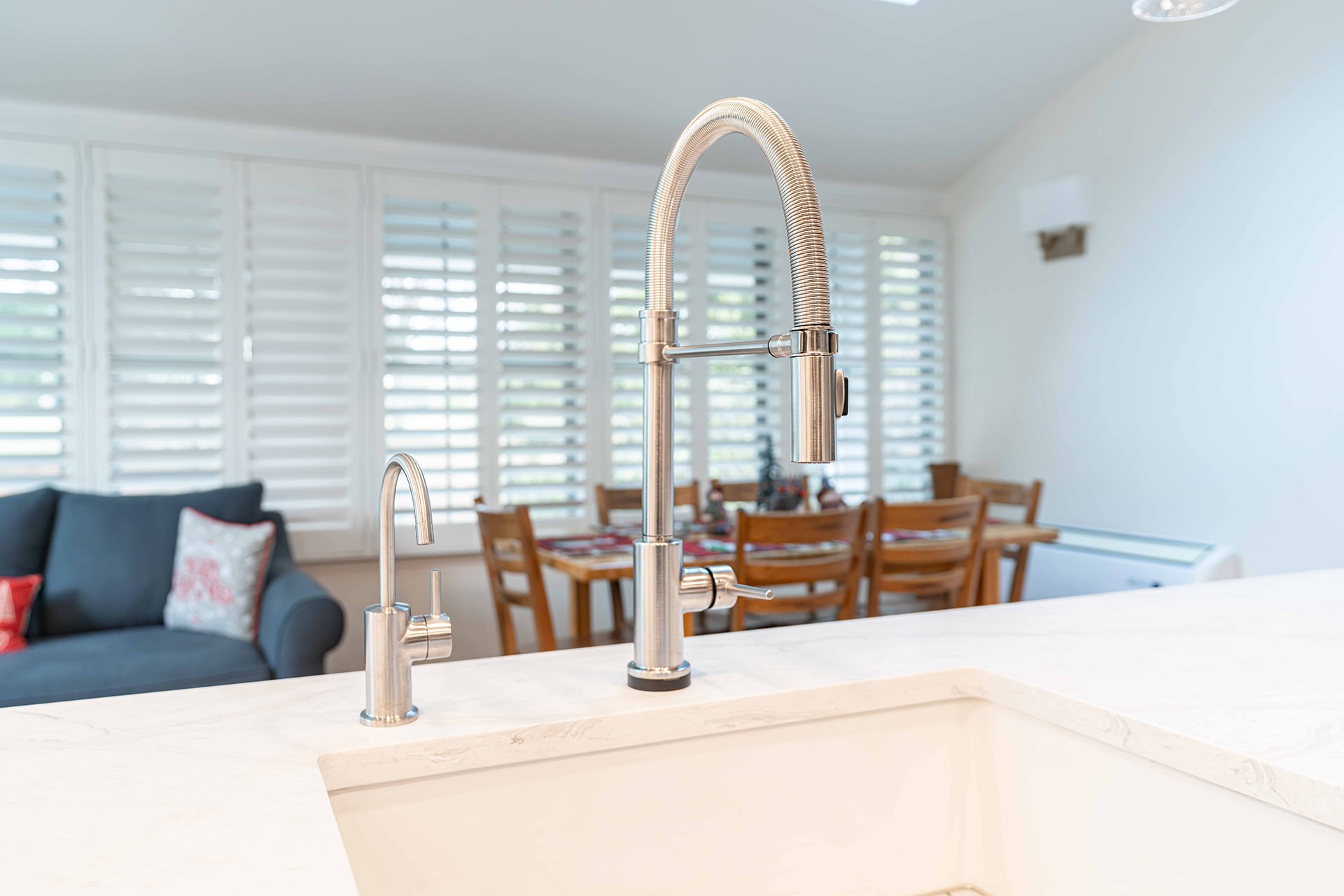
The countertops of this Jamison kitchen remodel are crafted in polished quartz with gentle veining, creating a durable and visually calming surface with eased edges and a clean negative reveal at the sink.
The best quartz products — Cambria, Silestone, Caesarstone — have grown considerably more sophisticated in recent years, with veining and movement that rival natural stone at a glance. For homeowners who want the look of marble without its maintenance demands, a well-chosen quartz slab can be a compelling solution. Where quartz falls short is in heat resistance: direct contact with a hot pan can damage the resin binders, and the material lacks the singular, unrepeatable character of stone pulled from the earth. In a kitchen designed around authenticity of material, that distinction matters.
Quartzite: Natural Stone That Earns Its Place
Quartzite is one of the most misunderstood materials in kitchen design. It is often confused with quartz, which it is not, and occasionally confused with certain marbles, which it resembles but outlasts. It is a naturally occurring metamorphic rock, formed when sandstone is subjected to intense heat and pressure, and it is considerably harder and more durable than marble. It holds up to heat, resists etching, and in most cases requires only periodic sealing to maintain its surface.
The aesthetic range of quartzite is remarkable. Super White, Taj Mahal, Sea Pearl — these stones offer the luminous, veined beauty that homeowners often associate with marble, but with a durability profile that suits a demanding kitchen. For those who want natural stone that will look extraordinary in twenty years with reasonable care, quartzite is frequently the answer we reach for first. It does command a premium, and slab selection matters enormously — two pieces from the same quarry can look quite different, which is why seeing the actual slab before purchase is always worth the effort.
Marble: Beautiful, Honest, and Worth Understanding
Marble has graced the kitchens of exceptional homes for centuries, and it continues to do so for good reason. The depth, luminosity, and movement of a fine Calacatta or Statuario slab is simply not replicated by any engineered product — and for homeowners who respond to the genuine article, no amount of reasoning about porosity will change that opinion.
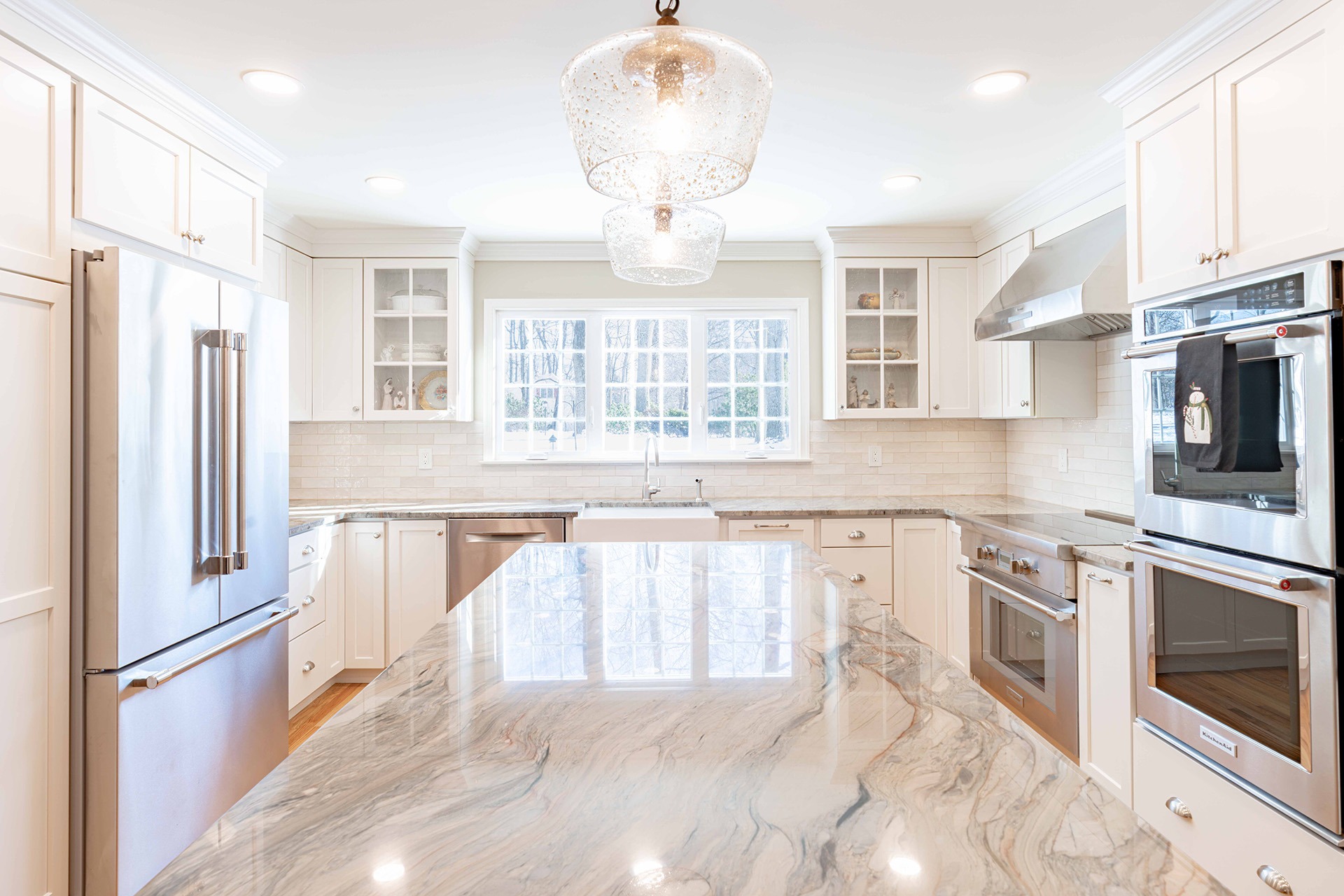
In this Doylestown kitchen, natural stone surfaces were used to create durable, elegant countertops with natural movement and visual interest, paired with a light, classic tile backsplash that reflects light and keeps the space feeling open and fresh.
What marble requires is honesty. It is a calcium carbonate stone, which means it is vulnerable to acids like citrus, vinegar, and wine that will etch the surface over time. It scratches more readily than quartzite. It patinas. And for some homeowners, that patina is precisely the point: a marble kitchen that has been lived in carries a beauty that a pristine engineered surface never will. The key is going in with clear eyes. Marble in a kitchen is a choice, not a compromise, but it is a choice that rewards those who understand what they are getting.
Beyond the Big Three: Soapstone, Dekton, and Sintered Stone
The countertop conversation has expanded meaningfully in recent years, and several materials deserve attention from homeowners willing to look past the familiar names. Soapstone — a dark, matte, naturally non-porous stone — has a quiet, almost Scandinavian character that works beautifully in kitchens with traditional or transitional architecture. It is impervious to acids and develops a rich, oiled patina that deepens over time. It is softer than other natural stones and will show scratches, though many soapstone owners find that quality part of its charm.

Dekton’s “Trance” line was chosen for the island countertop to contrast the clean, Traditional theme of this Flemington kitchen.
Sintered stone products — Dekton and Neolith among them — represent the serious edge of engineered surfaces. Formed under extreme heat and pressure, they are virtually impervious to scratching, heat, UV exposure, and staining. They can be produced in very large format slabs with minimal visible seaming, and in aesthetics ranging from concrete to marble to wood. For outdoor kitchens, kitchen islands that see heavy use, or homeowners who want maximum performance without sacrificing a sophisticated look, sintered stone is worth serious consideration.
The Question That Cuts Through Everything
The most useful question to ask before choosing a countertop material is not which one is most popular, or even which one is most durable. It’s: how do I actually use my kitchen, and what relationship do I want to have with this surface?
A household that cooks daily, has children, and entertains informally has different needs than one where the kitchen is primarily a space for weekend cooking and elegant dinner parties. A homeowner who finds the idea of a patinating marble surface deeply appealing will be far happier with that choice than one who selected it for its looks and discovers they resent every ring and etch. The right material is the one that fits how you live — and how you want to live — in your home.
This is a conversation we have with every client early in the design-build process, because countertop selection shapes not only the kitchen’s character but its cabinetry, lighting, hardware, and flooring. It is, in every sense, a foundational decision.
A Decision Worth Getting Right
At LBK Design Build, we’ve specified and installed countertops across the full range of materials — in kitchens from New Hope to Villanova, from historic Doylestown properties to newer construction throughout Montgomery County. We know which slabs are worth the premium, which fabricators do the most precise work, and how each material holds up not just at installation but over years of daily life.
If you’re beginning to think through a kitchen remodel, we’d love to bring that perspective to your project.