
There’s a moment many families recognize. Maybe it’s a parent who lives alone and could use more support. A college graduate back home while they find their footing. A sibling navigating a life transition. Whatever the circumstances, the question often surfaces quietly at first, and then more insistently: What if they just lived with us?
It’s a question more Bucks County homeowners are asking than ever before. Multi-generational living has surged in popularity across the country, driven by a combination of rising housing costs, an aging population, and a genuine desire to keep loved ones close. But wanting to share a home and being ready to design one are two very different things.
An in-law suite — sometimes called an accessory dwelling unit, a guest suite, or a secondary living space — is one of the most meaningful home additions a family can undertake. Done well, it creates privacy, independence, and connection all at once. Done without the right planning, it can become a source of friction, unexpected cost, or a space that simply doesn’t work the way anyone imagined.
At LBK Design Build, we’ve guided many Bucks County families through this process. Here’s what we’ve learned about what it takes to get it right.
Start with the Relationship, Not the Floor Plan
Before you think about square footage or where to put the kitchenette, have an honest conversation. Who will live in this space? What do they need day to day? How much independence do they want, and how much independence (from them) do you want?
These answers shape everything. A suite designed for an active parent in their 60s looks quite different from one designed for someone managing mobility challenges. A space for a young adult who needs a laundry hookup and a quiet place to work from home has different priorities than one for a grandparent who will need accessible features as the years progress.
Think, too, about the less tangible dynamics. Shared outdoor spaces, parking, separate entrances, and soundproofing. These aren’t just amenities, they’re the foundation of a healthy, sustainable living arrangement. The best in-law suites we’ve built feel both connected to the main home and genuinely separate from it. That balance is worth designing for from the very beginning.
Know Your Options: Addition, Conversion, or Detached?
In-law suites can take several forms, and the right one depends on your property, your budget, and how the space will be used.
A first-floor addition is often the most popular choice for families prioritizing accessibility. Building out rather than up allows for a self-contained suite that includes a bedroom, bathroom, living area, and sometimes a small kitchen. It connects to the main home but has its own entrance. This approach typically offers the most flexibility in layout and the clearest separation between households.
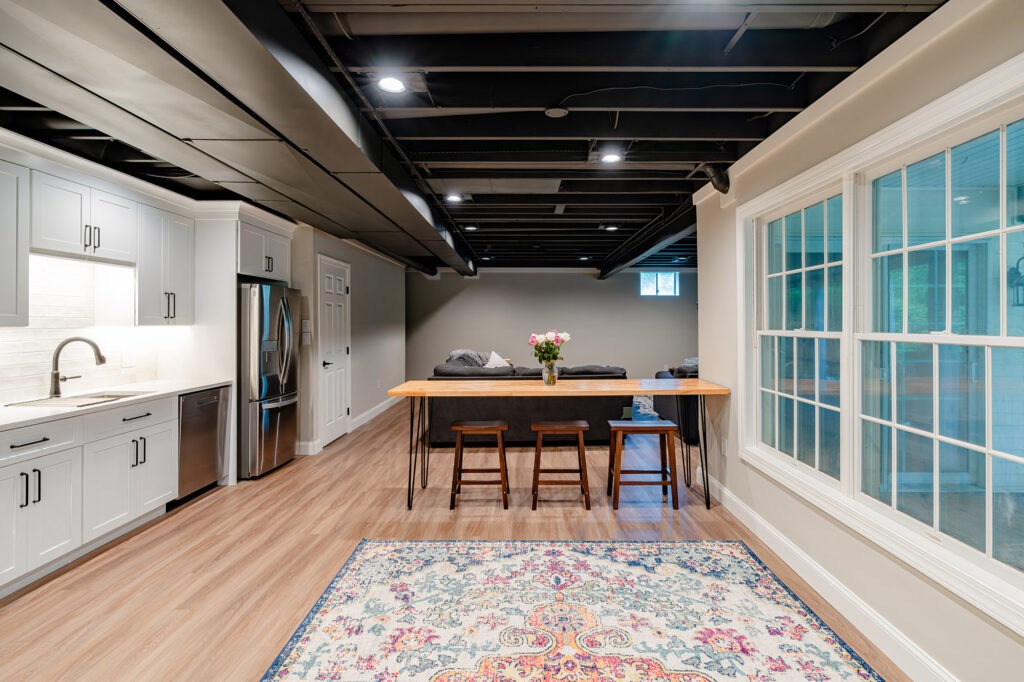
A basement conversion can be an excellent option when the existing footprint is already there. Finished basements in Bucks County homes often have the raw space needed for a comfortable suite, though egress, natural light, and moisture management require careful attention in the design phase.
A garage conversion — transforming an attached or detached garage into a living space — is another path worth exploring, particularly for homeowners whose properties have limitations on new construction. And in some cases, repurposing underused space on the main floor, such as a first-floor guest suite or home office that already has a bathroom nearby, can be the most cost-effective starting point.
Each approach comes with its own design and construction considerations, which is why early conversations with a design-build team are so valuable. Understanding what your home and lot can support before you fall in love with a particular layout saves time, money, and disappointment.
Zoning, Permits, and Local Regulations Matter More Than You'd Expect
One of the most common surprises for homeowners planning an in-law suite is discovering that what they envisioned may run into local zoning restrictions. In Bucks County and the surrounding region, regulations vary meaningfully from township to township. What’s permitted in Doylestown may require a variance in New Hope. What qualifies as an “accessory dwelling unit” in one municipality may be classified differently in another.
The questions worth investigating early include: Does your zoning district allow a second dwelling unit on a residential lot? Are there minimum lot size requirements? Is a separate kitchen permitted? Will a detached structure require a different permit classification than an attached addition?
Navigating this landscape is one of the reasons homeowners working with a design-build firm have an advantage over those managing the process themselves. At LBK, we research local codes and permit requirements as part of the planning process, so you’re not caught off-guard mid-project.
Design for Today and for Ten Years from Now
This is the consideration that separates a thoughtfully designed in-law suite from one that needs to be retrofitted within a few years.
If the suite is being built for an aging parent, universal design principles are worth building in from the start. Wider doorways typically accommodate wheelchairs and walkers without feeling institutional. A curbless, roll-in shower is both beautiful in a modern context and functional if mobility needs change. Lever-style door handles, comfort-height toilets, and blocking in walls for future grab bars are small details that make a significant long-term difference.
Single-floor living matters too. A suite that keeps the bedroom, bathroom, kitchen area, and laundry on one level eliminates the worry of stairs entirely.
It’s also worth thinking about how the space might evolve. A well-designed in-law suite can function as a guest suite when not in primary use, a short-term rental if local regulations permit, or a home office if circumstances change. Building in flexibility, particularly in the kitchen and bathroom finishes, adds long-term value and versatility to an already significant investment.

Understanding the Investment
In-law suite additions in the Bucks County market typically represent a meaningful investment, but one with both practical and financial returns. The cost will vary considerably based on size, scope, and whether the project involves new construction, a conversion, or a major renovation of existing space.
A few factors tend to move the budget more than others, like whether the suite includes a full kitchen or just a wet bar and mini-fridge, the extent of plumbing and electrical work needed, the level of finishes, and whether the project requires structural changes to the existing home.
It’s also worth understanding the broader financial picture. Adding a well-designed, code-compliant in-law suite typically increases your home’s appraised value and its appeal to future buyers. For many families, it also eliminates (or delays) the cost of assisted living or senior housing, which can dwarf the cost of a home addition many times over.
Why the Design-Build Model Makes a Difference Here
An in-law suite is not just a construction project. It’s a design challenge with real human stakes — the kind that benefits enormously from having your designer and your builder working as one team rather than two.
When design and construction are managed separately, details get lost in translation. A design that looks beautiful on paper may run into structural or budgetary realities that the architect wasn’t privy to. Timelines slip. Costs escalate. Communication breaks down.
With a design-build approach, all of those functions live under one roof. At LBK, your project moves from initial consultation through design, permitting, and construction with a single team who knows your goals, your family’s needs, and your home inside and out. That continuity isn’t just more convenient – it produces better results.
The LBK Way
Remodeling isn’t just about changing a space; it’s about improving the way you live in it. Livable Remodeling recognizes that your home is your daily life, not just a construction site. At LBK Design Build, we believe your renovation should be as enjoyable and stress-free as possible, blending exceptional craftsmanship with genuine consideration for your comfort.
Are you ready to transform your home without uprooting your life? Let’s talk about how Livable Remodeling can work for you.